Manufacturing
3D Printing
Jigs and fixtures, rapid prototypes, and low-to-medium volume production in silicone, nylon and other materials.

Jigs and fixtures, rapid prototypes, and low-to-medium volume production in silicone, nylon and other materials.
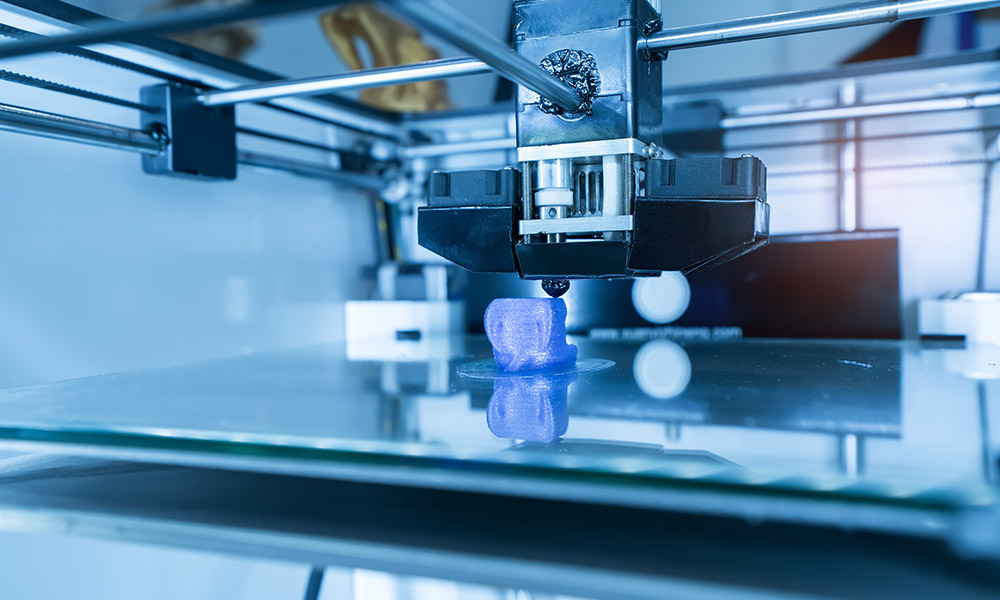
The 3D printer equipment list at Stockwell Elastomerics includes the following machines:
Stockwell Elastomerics uses a Formlabs Form 4 as its general-purpose printer. The Form 4 supports the use of dozens of resins, offers very fast print speeds, and has a build volume capable of printing multiple production and inspection fixtures as well as very small and precise silicone parts.
The Form 4 uses a version of masked stereolithography (MSLA) with a backlight and masking optics that hardens the resin into solid parts. With its high accuracy, surface finish, and part tolerances, the Form 4 can produce parts that are similar to injection-molded components in terms of appearance and fit.
Stockwell Elastomerics uses a Formlabs Form 4L for the rapid production of large-format parts. The Form 4L supports many of same materials as the Form 4 but simplifies high-volume work.
This 3D printer also achieves tight dimensional tolerances and produces high-quality parts with smooth surfaces. Applications include rapid prototyping for testing form, fit, and function, and high-resolution inspection fixtures (<0.005” resolution)
Stockwell Elastomerics uses a Markforged X7 to produce nylon parts that can rival machined metal or aluminum ones in terms of strength, stiffness, and durability. This 3D printer uses continuous fiber reinforcement (CFR) to create functional prototypes and parts for aerospace and robotics applications. Applications also include fixtures.
The Markforged X7 supports the use of nylon, nylon blends, and other thermoplastic materials. Continuous fiber reinforcements include carbon fiber, flame-retardant carbon fiber, fiberglass, and aramid.
Stockwell Elastomerics uses an Ultimaker S5 for general fixturing applications. This fused deposition modeling (FDM) printer features a large build volume and supports a wide range of materials. Options include PLA, tough PLA, ABS, nylon, CPE, CPE+, PC, PP, TPU 95A, and PVA. The Ultimaker S5 also supports printing with two different materials or in dual colors.
Compared to other types of 3D printers, the Ultimaker S5 excels at prototyping large, cost-effective, functional fixtures. Examples of parts printed in the past include general fixturing bodies as long as 4’ when bolted together.
Stockwell Elastomerics uses a Lynxter S300X to print silicone parts made of liquid silicone rubber (LSR) or room-temperature vulcanizing (RTV) silicone. Applications include components for soft robotics, seals and vibration dampeners, and medical components such as custom orthotic and prosthetic parts.
Using the S300X, Stockwell can print functional prototypes, using a wide range of production-grade, injection-mold ready silicone, allowing customers to test part function and material properties in days, not weeks.
Contact us for further assistance with 3D printing, including for jigs, fixtures, rapid prototypes, and low-to-medium production volumes in a range of sizes.