Ask a Question
Experts in Silicone Gasket Solutions

Material

Solid Sheet Rubber

Organic rubber best suited for less critical applications

Stockwell Elastomerics inventories a broad range of solid sheet rubber gasket materials to support requirements for Neoprene, Buna-N, EPDM and Viton™ fluoroelastomer gaskets. Although Stockwell Elastomerics is known for its extensive silicone rubber inventory, it is recognized that many applications are best served by other elastomers. For situations where a small quantity of a non-standard thickness or special compound is required, Stockwell Elastomerics may be able to satisfy the requirement using our 12″ x 12″ or 14″ x 14″ sheet molds.

Neoprene (Polychloroprene) has the advantages of good resistance to flame, weather, ozone, abrasion, flex cracking, alkalis and acids, with moderate resistance to oil and gasoline. We inventory military specification grades of neoprene in 40, 50 and 60 durometer certified to Mil-R-6855 Class 2. Stockwell Elastomerics also has high-grade commercial grade neoprenes in inventory, with 100% neoprene content for predictable performance in harsh environmental applications, and lower cost commercial grade neoprenes with 51% neoprene content when gaskets will not be exposed to chemical environments. Uncured compounds in 30, 40, 50, 60 and 70 durometer shore A are inventoried to support our fast-turn sheet molding capability.

Nitrile (Buna-N) is primarily used for applications requiring petroleum oil and gasoline resistance, but not intended for sunlight exposure. Stockwell Elastomerics inventories military specification grades of Buna-N in 40 and 60 durometer certified to Mil-R-6855 Class 1.

EPDM (Ethylene-propylene diene monomer) has excellent resistance to sunlight, ozone and heat, and good resistance to alkalis, acids and oxygenated solvents. Avoid applications where oil and other hydrocarbon fluids might be present.

Fluoroelastomer (Viton™) or fluorocarbon rubber withstands high temperatures in conjunction with aggressive chemicals, fuels and lubricants, along with resisting flame propagation, ozone and weather. However, fluorocarbon rubbers are severely attacked by highly polar fluids such as ketones, hydrazine, anhydrous ammonia and Skydrol (phosphate ester) hydraulic fluids. Post curing is required to achieve optimum properties. Stockwell Elastomerics inventories a high quality grade 70 and 80 durometer Viton™ sheet, and a 75 durometer specification grade certified to Mil-R-83248C, Type 2, Class 1.

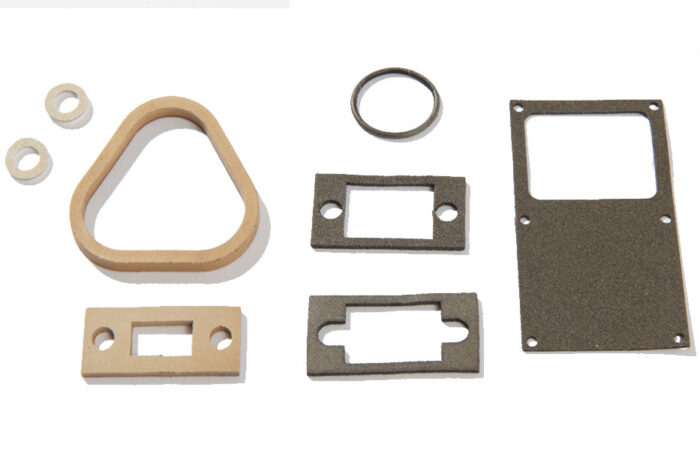
Stockwell Elastomerics die cuts solid rubber sheet materials into gaskets, and water jet cut gaskets to customer specifications. Water jet cutting of solid rubber gasket materials from .015″ to 1.0″ thick can be done quickly from your dxf or dwg file.

Special sheet rubber gauges and compounds can be molded from our 12″ x 12″ and 14″ x 14″ sheet molds. The combined versatility of die cutting, water jet cutting and custom molding is rarely found in one rubber gasket manufacturer.

Visit the Closed Cell Rubber / Neoprene Data Sheets page for detailed technical information on these materials.

Frequently Asked Questions about Solid Sheet Rubber

What is solid sheet rubber?

Solid sheet rubber is a dense, non‑cellular elastomer that’s supplied in flat sheet form. Unlike closed cell sponge or foam, solid sheet rubber does not contain pockets of air. This provides solid sheet rubber with strength and dimensional stability, tear resistance, and strong sealing performance under high compressive forces.

What types of solid rubber sheet does Stockwell Elastomerics offer?

Stockwell Elastomerics offers solid rubber sheet made from silicone, fluorosilicione, and fluoroelastomer (FKM) materials. Each elastomer provides specific chemical, temperature, and performance properties.

What are some applications for solid silicone sheet?

Solid silicone sheet maintains its flexibility and sealing performance across a wide range of temperatures. Applications include high-temperature gasketing, outdoor weather sealing, and electrical insulation. Depending on the specific grade, solid silicone sheet is also used in food, medical, military, or aerospace applications.

What grades of solid silicone sheet does Stockwell Elastomerics offer?

Stockwell Elastomerics supplies solid silicone sheet in the following grades:

  • General‑purpose
  • High‑strength / high tear resistance
  • Flame‑retardant (UL 94 V‑0, FAR 25.853)
  • FDA‑compliant
  • Electrically conductive

These grades are available in various durometers, typically from 40 to 70 Shore A.

What are the available thicknesses for solid silicone sheet?

Stockwell Elastomerics offers solid sheet rubber in thicknesses ranging from 0.010″ to 0.500″, depending on the material. Thicker sheets can withstand greater bolt loads and create a more robust seal against pressure fluctuations. However, they also require higher compressive force and have a greater risk of uneven compression.

Can solid sheet rubber withstand outdoor exposure?

Yes, but it depends on the elastomer. For example, silicone is used outdoors because it resists water, sunlight, and ozone. Fluorosilicones and fluoroelastomers also resist harsh conditions, but they’re chosen for their temperature and chemical resistance instead. This gives them an advantage over a material like Nitrile, which is not recommended for outdoor use due to its degradation when exposed to direct sunlight and ozone.

What temperatures can solid rubber sheets withstand?

Temperature resistance varies by the type of elastomer.

  • Silicone: –100°F to +500°F (-55°C to +260°C)
  • Fluorosilicone: -70°F to 450°F (-60°C to +204°C)
  • FKM: –32°F to +400°F (-26°C to 204°C)

Does solid rubber sheet resist chemicals?

Chemical resistance also depends on the type of elastomer.

  • Fluorosilicone and FKM resists fuels, oils, and solvents.
  • Silicone resists many common chemicals but not aggressive ones.

What should engineers consider when designing a gasket from solid sheet rubber?

In addition to chemical exposure and temperature range, engineers should consider the following:

  • Durometer: Determines sealing force and flexibility
  • Thickness: Affects compression, sealing, and mechanical strength
  • Flange Stiffness: Prevents bowing and uneven sealing

What’s the practical difference between harder and softer solid sheet rubber?

Lower durometers are softer and conform more easily to sealing surfaces. They’re recommended for low-pressure sealing or applications with limited clamping force. Higher durometers are harder and provide greater mechanical strength. They also require higher compressive forces. Medium durometers are typically used for general-purpose gaskets.

Contact Stockwell Elastomerics for Solid Sheet Rubber

Contact Us for further assistance with solid sheet rubber, neoprene, Nitrile (Buna-N), EPDM and Viton™ fluoroelastomer products to fabricate into gaskets and other solid rubber sheet components.
Viton™ is a trademark of The Chemours Company FC, LLC.

Contact Stockwell Elastomerics

Request a quote or get more information.