Contact Stockwell Elastomerics
Request a quote or get more information.

Design engineers and procurement teams have multiple options when specifying electrically conductive elastomers for EMI shielding gaskets. Stockwell Elastomerics can help evaluate U.S.-made conductive silicone and fluorosilicone materials, including options qualified to MIL-DTL-83528, and convert selected materials into custom EMI gaskets.
Have an existing material specification? Send Stockwell the material number, drawing, or performance requirements to evaluate comparable options.
Conductive elastomer selection does not have to be limited to a single material manufacturer.
U.S.-made conductive silicone and fluorosilicone materials are available for a range of EMI shielding applications, including aerospace, defense, electronics, telecommunications, instrumentation, and industrial equipment.
Stockwell Elastomerics works with engineers to evaluate these materials based on the requirements of the finished gasket—not simply a material name or cross-reference.
Depending on the application, selection criteria can include:
Yes. Stockwell works with U.S.-made electrically conductive silicone and fluorosilicone materials for custom EMI gasket applications.
For OEMs with U.S.-manufacturing, defense, aerospace, or sourcing requirements, these materials provide an additional option when developing or qualifying an EMI shielding system.
Stockwell also provides U.S.-based custom gasket fabrication in Philadelphia, Pennsylvania, supporting the path from initial material evaluation and prototype through production.
MIL-DTL-83528 defines requirements for electrically conductive elastomeric shielding gaskets used for EMI/RFI suppression.
Available U.S.-made material options include QPL-listed conductive elastomers covering multiple MIL-DTL-83528 material types.
Depending on the required type, materials may use silicone or fluorosilicone base elastomers combined with conductive fillers such as silver-plated aluminum or silver-plated copper.
The correct choice depends on the applicable MIL-DTL-83528 type as well as the environmental and mechanical requirements of the gasket assembly.
Yes. Cross-referencing can help identify candidate materials when an engineer wants to evaluate an additional source.
Commonly specified conductive elastomers have U.S.-made material alternatives across several conductive filler and base-polymer systems.
A cross-reference, however, should be treated as the beginning of the engineering review rather than proof that two materials are universally interchangeable.
Stockwell recommends comparing:
| Design Requirement | What to Evaluate |
|---|---|
| Electrical performance | Volume resistivity and conductivity |
| EMI performance | Shielding effectiveness and frequency range |
| Environmental sealing | Compression and gasket design |
| Mechanical properties | Durometer, tensile properties and compression behavior |
| Environment | Temperature, moisture, fuel and chemical exposure |
| Corrosion | Conductive |
Conductive filler selection affects both electrical performance and environmental compatibility.
Silver-plated aluminum conductive silicone can provide very low volume resistivity and high EMI shielding performance. Nickel-graphite systems can provide a different balance of electrical performance, galvanic compatibility, and cost.
Silver-copper and other conductive filler systems may be appropriate where specific MIL-DTL-83528 requirements apply.
The highest-conductivity material is not automatically the best gasket material. The complete enclosure, mating surface, environment, compression level, and shielding requirement should be evaluated together.
Conductive fluorosilicone combines EMI shielding capability with improved resistance to fuels and certain chemicals compared with conventional silicone.
That can make fluorosilicone particularly useful for aerospace and defense applications where the gasket must provide both environmental sealing and electrical continuity while exposed to demanding fluids.
For applications without significant fuel or chemical exposure, conductive silicone may provide a more appropriate performance and cost balance.
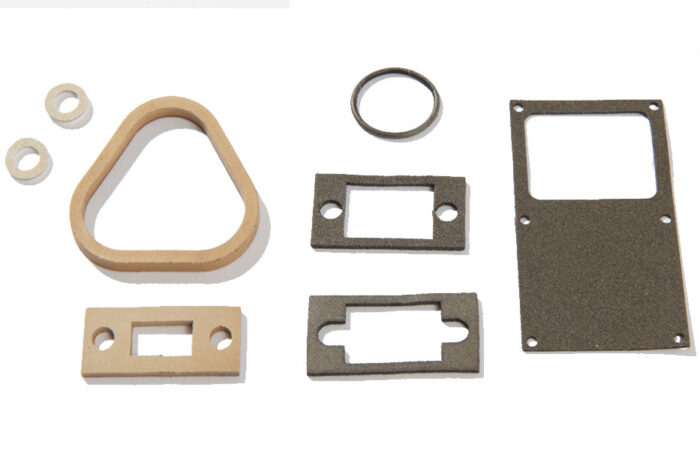
Yes. Stockwell Elastomerics converts electrically conductive elastomers into custom EMI shielding gaskets for prototype and production applications.
Our Applications Engineering Team can support material selection, gasket design review, and fabrication method selection based on geometry, tolerances, quantity, and performance requirements.
Stockwell’s U.S.-based capabilities provide a path from:
This allows engineers to evaluate both the conductive elastomer and the manufacturability of the finished gasket as part of the same sourcing process.
Stockwell Elastomerics specializes in custom elastomer components for demanding OEM applications.
Customers work with Stockwell for:
The objective is not simply to find another material number. It is to identify a material and fabrication approach that meets the electrical, environmental, mechanical, compliance, and manufacturing requirements of the application.
Start with your existing material specification, drawing, or performance requirements.
Stockwell’s Applications Engineering Team can help identify candidate conductive elastomers and review the requirements that determine material fit.
Call 215-335-3005, email service@stockwell.com, or submit your requirements through the Stockwell RFQ form.