Contact Stockwell Elastomerics
Request a quote or get more information.

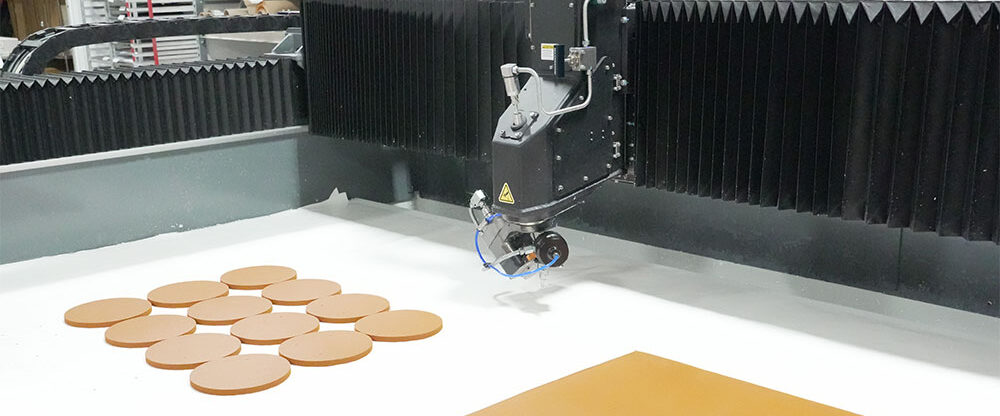
Stockwell Elastomerics offers a choice of rapid prototyping techniques for custom silicone gaskets and EMI pads. Choices include flash cutting, water jet cutting, die cutting, and on-demand molding. Some of these cutting and molding techniques also support low, medium, or high volume production. To select the best rapid prototyping method, engineers need to consider lead times, tolerances, and cost scaling.
Flash Cutting
Flash cutting can cut most high consistency silicone rubber (HCR) at speeds conducive to quick-turn prototyping. This fabrication process uses a digital knife cutting system instead of custom tooling. Consequently, Stockwell Elastomerics can turnaround prototype parts in as quickly as one day. Tolerances of +/-0.010 on small features are achievable, but flash cutting is scalable only to small or medium volume production.
Waterjet Cutting
Waterjet cutting can quickly produce samples for immediate testing. No cutting tools are required, and Stockwell Elastomerics can provide prototype parts in as quickly as one day. For custom silicone gaskets and EMI pads, the tolerances are comparable to those of flash cutting. Waterjet cutting makes intricate, accurate cuts and is scalable to mass production at small to medium volumes. It’s a good choice when steel rule die cutting or injection molding is planned for higher volumes.
Die Cutting
Die cutting is generally used for high-volume production rather than rapid prototyping. That’s because this gasket fabrication process uses a metal tool, or die, that needs to be machined. Die cutting is cost-effective when the cost of the die can be spread across many parts, but rapid prototyping usually involves very low volumes. Once the tool is made, however, die cutting is faster than water jet cutting. Yet its tolerances are less exact because the die causes edge concavity dependent on the material thickness.
Laser Cutting
Stockwell Elastomerics does not use laser cutting for rapid prototyping (or production) because of limitations with this process. Like water jet cutting, laser cutting is a tool-less process; however, laser cutting has the potential to burn or char the edges of parts. In addition, laser cutting produces fumes. Although laser cutting can be used for projects ranging from rapid prototypes to high-volume production, its tolerances and cost-scaling don’t outweigh its disadvantages.
Compression Molding
Compression molding can be a rapid prototyping process dependent on the part size, molds can be produced in as little to two weeks to accommodate initial production runs. The standard production quantities that compression molding can support are 500 to 20,000 pieces. Certain molded materials can only be processed via compression molding, such as fluorosilicone. Generally, the molding tolerances are RMA A2 (Precision) or RMA A3 (Commercial). The cost of a compression mold is usually less than an injection mold, but there’s still tooling to pay for and wait for, which can add to the tooling lead time. That said, Stockwell has the capability to provide rapid prototype steel tooling to produce limited quantities of prototype parts quickly, sometimes cutting lead times in half. But, because rubber compression molding is a labor-intensive activity with longer cure cycles, Stockwell Elastomerics may recommend liquid injection molding instead.
Liquid Silicone Injection Molding
Liquid silicone injection molding (LIM) has cure cycles that can take from 30 seconds up to 2 minutes. Faster cycle times support shorter lead times, but LIM requires molds that can be relatively expensive. Consequently, this molding process is generally used for high-volume production instead of rapid prototyping. Tolerances for silicone LIM vary, but tighter ARPM A2 tolerances are achievable depending on the material, tool quality, and part geometry.
Contact Stockwell Elastomerics for more information about rapid prototyping for custom silicone gaskets and EMI pads. Our Applications Engineering team is available through email service@stockwell.com or 215-335-3005.