Contact Stockwell Elastomerics
Request a quote or get more information.

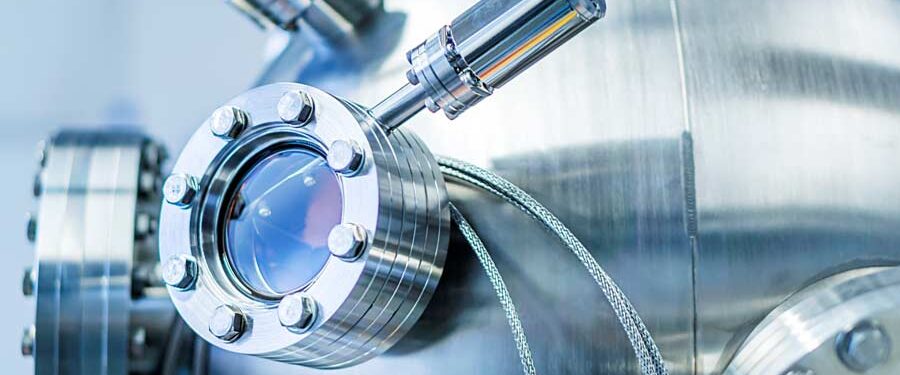
Low outgassing materials release minimal levels of volatiles when exposed to vacuum pressure or heat. Polymers, including some silicones, are susceptible to outgassing but can be formulated and processed to have low levels of volatile elements and compounds. Low outgassing materials are used in applications where volatiles could condense on critical surfaces and interfere with optical, electrical, or mechanical systems.
Stockwell Elastomerics specializes in silicone gaskets and fabricates low outgassing materials for spacecraft and space vehicles, semiconductor manufacturing, defense electronics, analytical instrumentation, LED lighting, and medical devices and equipment. Low outgassing silicones have very low levels of unreacted volatiles such as low-molecular-weight siloxanes. They’re typically tested to ASTM E595, a standard method for measuring the outgassing properties of materials.
What is Outgassing? Why Is It a Problem?
Outgassing is the release of volatiles from a material as gas molecules. In solids and liquids, there are four mechanisms: diffusion, vaporization, desorption, and permeation. No matter how it occurs, outgassing is a problem when gas molecules that escape from a material condense upon and cloud surfaces such as camera lenses, sensors, and electronics. Typically, this occurs when a material is exposed to very low pressure (i.e., a vacuum) and/or high heat.
ASTM E595 and Outgassing Tests
ASTM E595 establishes outgassing tests that are used to measure the following.
ASTM E595 is associated with spacecraft and space vehicles, but it’s not limited to them.
How NASA Defines Low Outgassing Materials
Space is a near-perfect vacuum, and the surfaces of satellites and spacecraft heat up as they absorb solar radiation. In Earth orbit, surfaces facing the Sun can reach as high as 250°F (120°C). Under these low pressure and high temperature conditions, outgassing can cloud space telescopes and degrade the performance of solar arrays and avionics.
ASTM E595 provides a framework for measuring TML, CVCM, and WVR, but it’s not the last word on what constitutes a low outgassing material. For engineers who need to meet NASA requirements, it’s important to note that NASA-STD-6016 specifies that a non-metallic material (such as a silicone) must meet the following criteria to be considered low outgassing.
Other Industries That Need Low Outgassing Silicones
Low outgassing materials, especially silicones, are also used with the lithography optics and vacuum chambers in semiconductor manufacturing equipment. That’s because molecular contamination can cause pattern defects, yield loss, and optical haze. Similarly, outgassing with optics and photonics can cause fogging or haze with camera modules, laser assemblies, LiDAR systems, and night-vision optics.
With defense electronics, silicone outgassing can contaminate detector surfaces as well as precision optics. Consequently, low outgassing materials are used with radar and missile guidance systems. Analytical instruments such as mass spectrometers use these specialized materials to avoid ghost peaks. LED lighting uses them to prevent fogging. Medical devices and equipment that are sterilized in an autoclave also use low outgassing silicones for gasketing.
Stocked Materials with Low Outgassing
Stockwell’s application engineering team is available to help determine which silicone grade best aligns with your application requirements. We maintain a large inventory of select silicone foams, sponges, and solid materials to support rapid prototyping and small-quantity sampling for development builds. Stockwell supports low and high-volume production, and our manufacturing is proudly Made in USA.
Contact Stockwell Elastomerics for more information.