Contact Stockwell Elastomerics
Request a quote or get more information.

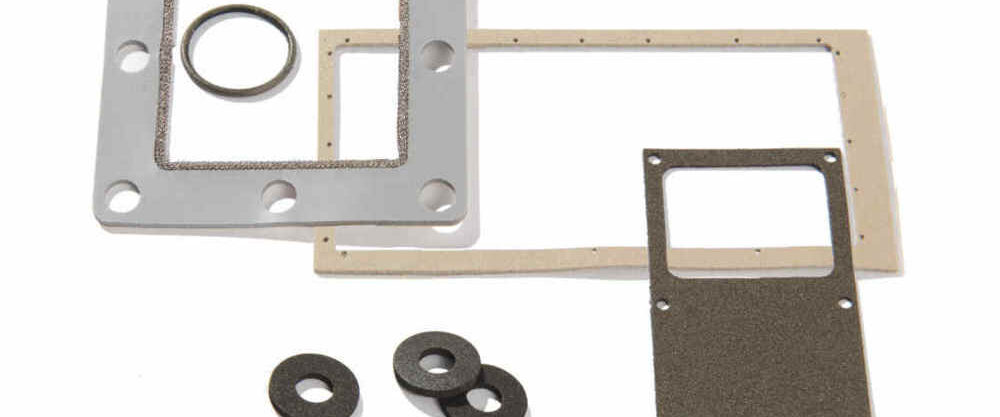
Conductive elastomers that are fabricated into EMI gaskets provide environmental sealing and shielding against electromagnetic interference (EMI) in electrical and electronic enclosures. Most rubber materials are electrically insulating, but conductive elastomers contain metal particulate or strand, bimetallic, or metal-coated particles that impart electrical conductivity.
There are different types of conductive rubber, but electrically conductive silicones resist moisture, contaminants, and a wide range of temperatures while allowing engineers to balance shielding performance with softness as measured on the Shore A scale.
When to Use Conductive Silicone Gaskets
Conductive silicone gaskets combine the material and performance properties of silicones with electrical conductivity. Whether they are cut or molded, these EMI seals fill gaps between lids and panels that would otherwise admit environmental contaminants and unwanted electrical interference. They also maintain their resilience under repeated compression cycles. With silicone as the base material, these gaskets can also support enclosure designs that require Ingress Protection (IP) ratings.
Depending on the filler that’s used, conductive silicone gaskets can resist galvanic corrosion, a problem in marine environments. Electrically conductive silicones are also available with UL 94V-0 flame resistance, and in compounds that meet the lettered requirements in the U.S. military’s MIL-DTL-83528 specification. Silver-coated fills provide higher levels of electrical conductivity, while silicones that contain nickel-aluminum or nickel-graphite particles are cost-effective.
When to Use Metallic Plating
Metallic plating can be used in conjunction with conductive elastomers, but not as a substitute for gasketing. Typically, metallic plating, paints, coatings, or films are sprayed onto the sides and lids of metal or plastic enclosures. They create a hard, wear-resistant surface with a uniform coating and minimal thickness. Depending on the plating material that’s used and how it’s applied, the shielding effectiveness can match or exceed that of a conductive elastomer.
Although it’s possible to plate or coat a non-conductive rubber gasket, plated metals are brittle and tend to crack or flake when a gasket is compressed. Similarly, metallic films or coatings tend to wear under compression. Plus, silicone rubber has low surface energy and may require an adhesion-promoting primer or surface treatment. Plating can improve enclosure shielding, but conductive elastomers are needed to seal-out the environment along with unwanted signals.
Shielding Performance vs. Softness
When specifying conductive elastomers, engineers need to balance shielding performance with softness. As a rule, higher filler content increases electrical conductivity but stiffens the elastomer. With EMI shielding, this is a concern because adequate compression is needed to ensure continuous conductive paths across mating surfaces. Stiffer gaskets require higher compressive forces, but this can comprise environmental sealing if an enclosure’s surfaces are uneven.
Softer conductive elastomers can accommodate misalignments and reduce stress on enclosure hardware while still providing EMI shielding and environmental sealing. They also reduce wear on mating surfaces when enclosures are opened and closed repeatedly. Softer materials can lose their resilience over time, however, and this reduces sealing effectiveness. In addition, softer materials may not be suitable for some applications because of their EMI attenuation levels.
Particle-Filled EMI Gaskets vs. Combination EMI Gaskets
EMI gaskets made of particle-filled silicones come in various durometers, but these solid elastomers are harder than combination EMI gaskets. Typically, a closed-cell silicone sponge is specified for a combination EMI gasket because of its long life, weather resistance, and functional temperature range. This gasket material contains a knitted wire cord, typically made of Monel, for conductivity.
To discuss selecting a conductive elastomer for your project, our Applications Engineering team can be reached via phone at 215-335-3005 or service@stockwell.com. Stockwell Elastomerics maintains a large inventory of silicone materials, including particle-filled silicones and fluorosilicones and combination EMI gaskets that require less compression force.