Contact Stockwell Elastomerics
Request a quote or get more information.

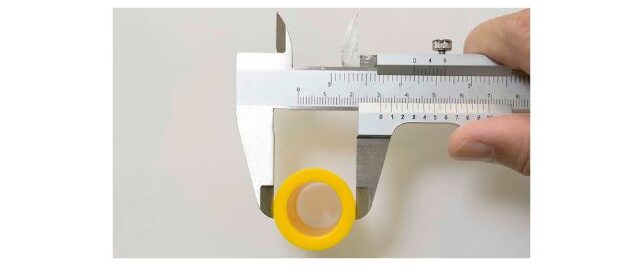
Silicones have different dimensional tolerances than rigid materials like metals and engineering plastics. Silicones are softer, but that’s not the only reason that they have “looser” tolerances and greater dimensional variability from part-to-part. Understanding why this is the case is important, but it’s just part of what engineers need to know when designing silicone parts like custom gaskets.
This article from Stockwell Elastomerics compares silicone tolerances to those of rigid materials. It also considers the relationship between silicones properties and dimensional tolerances. Some silicone properties can be adjusted, but even spec-grade materials have looser tolerances than metals and plastics. Silicones also vary in weight between batches.
Silicone Tolerances vs. Metal and Plastic Tolerances
Metals and plastics can be machined to tolerances as tight at ±0.01 mm. Their rigidity and predictable thermal expansion ensure dimensional stability, and their surface finish and geometry can be controlled with relative precision. Rigid plastics such as PEEK, ABS, and polycarbonate can also be injection-molded instead of machined. Cooling-related shrinkage is highly predictable, and tolerances generally range from ±0.05 mm to 0.1 mm.
Silicone tolerances are looser because these elastomers deform easily, exhibit greater batch-to-batch variability, and use different manufacturing processes (such as die cutting and liquid injection molding (LIM)). Depending on part size and geometry, silicone tolerances generally range from ±0.25 mm to 0.5 mm. Silicones are also viscoelastic, which means that they exhibit both elastic and viscous behavior when deformed.
Silicone Properties and Material Tolerances
Silicone elastomers can be customized with fillers, additives, and curing agents to modify properties such as hardness, thermal or electrical conductivity, and color. Nevertheless, silicones remain more flexible than metals and plastics. Moreover, their densities vary within a relatively narrow band. In addition, silicones expand and contract more in response to temperature changes. With their viscoelastic properties, time-dependent deformation such as stress relaxation can occur.
Because silicones deform under compression, measuring part dimensions with calipers or gauges can be imprecise. Depending on how a silicone part is handled, additional compression or stretching may occur. Slight differences in viscosity or filler dispersion during silicone molding can also affect final dimensions. Post-cure shrinkage varies by formulation, mold design, and curing conditions. Importantly, silicone shrinkage is less predictable than with injection molded plastics.
Thickness Tolerances and Batch-to-Batch Weight Variations
Thickness tolerances for silicones are usually ±0.25 mm for molded sheets or gaskets. For extruded silicone sheets, tolerances that are 10% of the nominal thickness are typical. To account for silicones’ looser tolerances, engineers sometimes specify thickness ranges instead of exact values. For best results, validate these tolerances with both functional testing and dimensional inspection.
Compared to rigid materials like metals or plastics, silicones also vary more by weight between batches. There are several reasons for this. Slight differences in filler loading or dispersion affect silicone density, and longer or hotter cures that remove volatiles reduce weight incrementally. The absorption of small amounts of moisture can also affect a silicone’s weight. Because of these factors, Stockwell Elastomerics does not weight silicone materials or provide silicone part weights.
Learn More About Silicone Tolerances
Understanding silicone tolerances is an important aspect of custom gasket design. Contact Stockwell Elastomerics via our form or service@stockwell.com for more information and ask to speak with a member of the Applications Engineering Team about how silicone tolerances may affect your application.