Contact Stockwell Elastomerics
Request a quote or get more information.

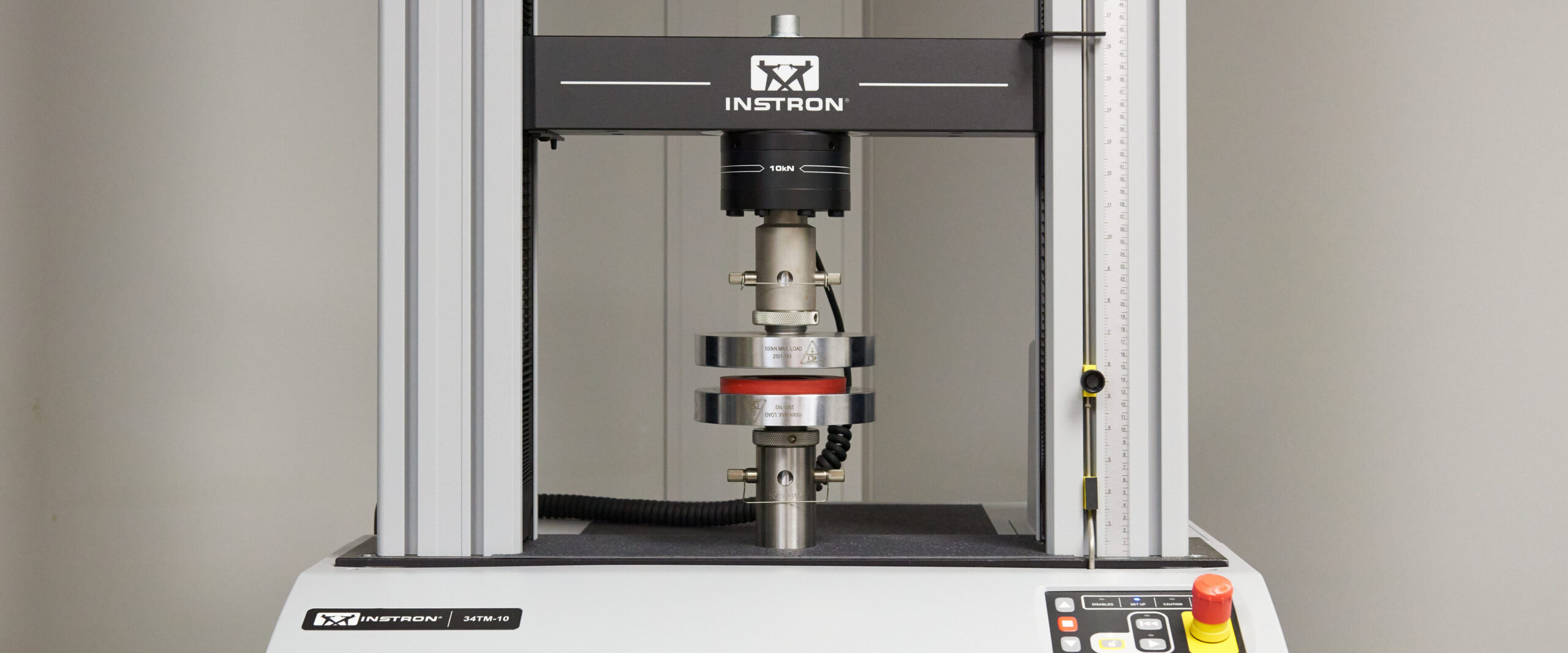
Compression force deflection (CFD) is the amount of force that’s required to compress an elastomeric material to a specified percentage of its thickness. Because an enclosure gasket seals properly when it’s compressed within an optimal range, CFD data indicates how much force an enclosure must generate to provide predictable and reliable sealing.
Through CFD testing, design engineers can compare different materials in terms of their compressive behavior. CFD testing helps with material selection, but it also provides the data that engineers need for seal-force calculations, fastener selection, housing design, and tolerance stack-ups. Stockwell Elastomerics performs CFD testing and can help you evaluate your seal design.
Why Compression Force Deflection Matters
CFD testing quantifies the relationship between an applied force and the resulting deflection – the amount of change in a gasket’s thickness. Engineers use CFD test data to understand how a material will behave when clamped between surfaces. This data is represented graphically on a CFD curve and helps engineers answer these questions:
Seal Force Calculations
Seal performance depends on achieving the proper compression percentage. CFD data describes the amount of force, typically in pounds per square inch (psi), that’s required to achieve this compression level. Engineers can then use this data to calculate clamp load requirements, fastener torque values, required housing stiffness, and deflection behavior.
For example, a silicone foam with a CFD of 5 psi at 25% compression requires significantly less clamp load than a solid silicone with a CFD of 40 psi at the same compression level. If the enclosure cannot generate the required force, the gasket will not conform to gaps and will leak. Conversely, if the enclosure generates too much force, a soft gasket may take a permanent compression set and become deformed.
Material Comparison
As the example above suggests, different formulations of the same type of material (i.e., silicone elastomers) can have very different CFD profiles.
Design Validation
CFD data is used in design validation, especially when prototyping reveals unexpected sealing behavior. For example, engineers may discover under-compression due to insufficient clamp load or over-compression that causes permanent deformation. Engineers can then adjust the material family, gasket thickness, hardware spacing, fastener torque, housing stiffness, or material durometer.
It’s important to note that CFD curves do not include durometer or temperature as variables on the chart. CFD curves are generated at a standard temperature as dictated by the particular ASTM standard for the material type (i.e. foam, sponge) that is being tested. Temperature doesn’t appear in CFD data, but CFD vs. Temperature curves indicate how much force is required to reach a specific compression percentage at various temperatures. Different material durometers can each have their own, geometry dependent CFD curves, and are treated as separate materials.
Stockwell’s Testing Capabilities
Stockwell Elastomerics provides comprehensive material testing services to support design engineers who need accurate, repeatable data. In addition to compression force deflection testing, Stockwell offers compression set testing, environmental and thermal testing, material characterization, and custom material evaluation.
By leveraging Stockwell Elastomerics’ testing capabilities, engineers can design enclosure gaskets that perform consistently, reliably, and predictably. To talk to our Applications Engineering Team, complete our on-line form, email service@stockwell.com, or call (215) 335-3005.