Contact Stockwell Elastomerics
Request a quote or get more information.

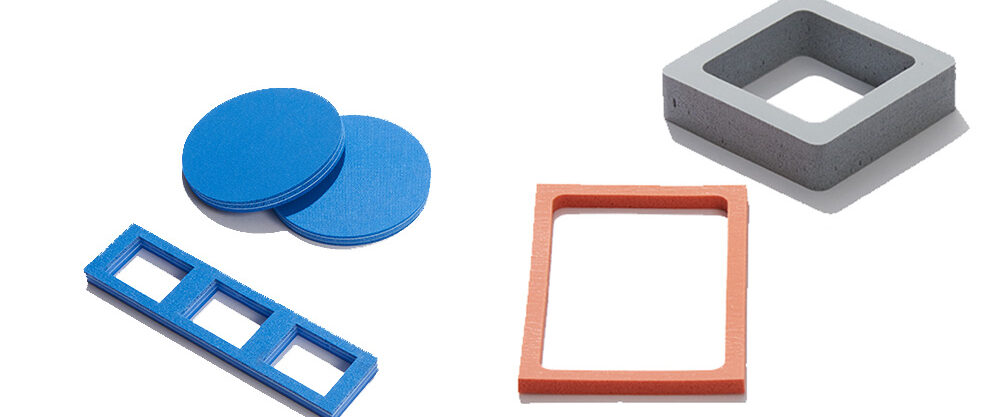
The aerospace industry uses elastomeric materials for environmental sealing, thermal and electrical insulation, and – in some cases – shielding against electromagnetic interference (EMI). Standard silicone and fluorosilicone both resist compression set and wide range of temperatures; however, there are important differences between these molecularly similar materials.
These differences become evident when an aerospace gasket encounters aggressive aviation fluids, non-polar solvents, or harsh environmental contaminants. Stockwell Elastomerics converts aerospace grade silicones and fluorosilicones into finished parts and can help design engineers with material selection, including compliance with AMS or other specifications.
Chemical Resistance and Aviation Fluid Compatibility
Exposure to aviation fluids can cause seal failure in both airborne platforms and ground support equipment. When immersed in petroleum-based fluids, for example, standard silicone swells significantly. In addition to physical distortion, the effects include softening and a loss of tensile strength. By contrast, fluorosilicone maintains its dimensional stability and physical integrity.
The table below compares the chemical resistance of standard silicone and fluorosilicone.
| Fluid Category | Aviation Fluids | Standard Silicone | Fluorosilicone |
|---|---|---|---|
| Jet Fuels | Jet A, Jet A-1, JP-8 | Poor | Excellent |
| Aviation Gasoline | Avgas 100LL | Poor | Excellent |
| Synthetic Lubricants | MIL-PRF-7808, MIL-PRF-23699 | Poor to Fair | Excellent |
| Deicing Fluids | Glycol-based solutions | Good | Excellent |
| Coolants & Dielectrics | Polyalphaolefin (PAO) | Poor | Excellent |
| Phosphate Ester Hydraulics | Skydrol® | Fair to Good | Poor to Fair |
Important: Fluorosilicone offers broad fluid resistance, but it does not resist all aviation fluids. For example, exposure to polar solvents like Skydrol® can cause material degradation.
Mechanical and Thermal Trade-Offs
Fluorosilicone generally excels in fluid-exposed environments, but standard silicone retains key advantages in terms of thermal and mechanical performance.
Note: Silicone is also available in ultra-soft closed-cell foams. Closed-cell fluorosilicone sponge comes in low-closure-force formulations for use with lightweight enclosures.
Aerospace Specifications and Applications
Aerospace applications may require silicone or fluorosilicone materials that meet industry or military specifications besides the numbered designations within AMS. For example, sensor systems on craft exterior and access doors need materials that resist continuous fuel spray and vapors. Fluorosilicone materials that comply with AMS-R-25988 or MIL-DTL-25988 avoid swelling under these conditions.
Stockwell Elastomerics fabricates these spec-grade fluorosilicones via cutting and molding to meet A-A-59588, which is limited to solid silicone materials. Applications include door seals, window seals, canopy gaskets, and exhaust hangers. Stockwell Elastomerics also fabricates EMI gaskets from silicones and fluorosilicones that meet MIL-DTL-83528 requirements.
Compare Fluorosilicone vs. Silicone for Aerospace
Stockwell Elastomerics is an experienced gasket fabricator that can help aerospace engineers compare fluorosilicone vs. silicone materials. Because fluorosilicone is significantly more expensive than standard silicone, it’s a conversation worth having. To talk to our Applications Engineering Team, complete our on-line form, email service@stockwell.com, or call (215) 335-3005.