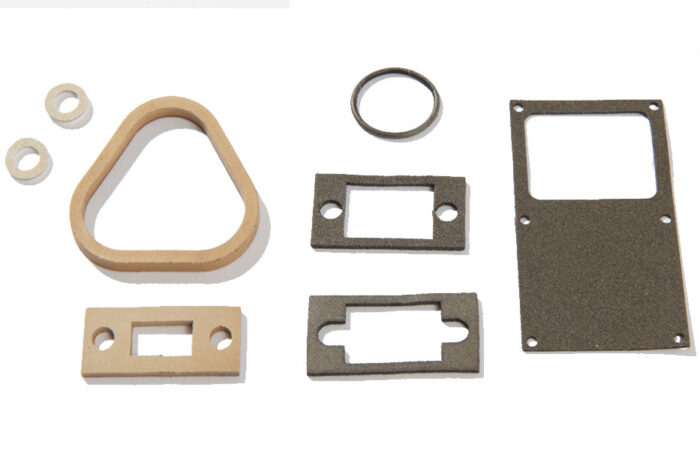
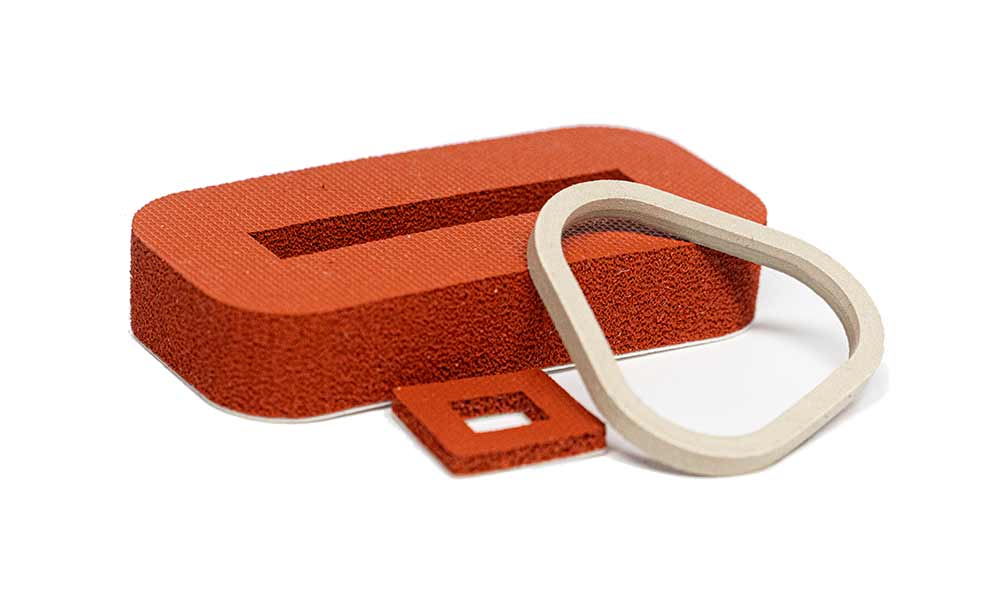
Silicone seals prevent the ingress of dust, moisture, and other contaminants while maintaining their material properties under demanding environmental conditions. Stockwell Elastomerics maintains a large inventory of silicone elastomers from leading suppliers and fabricates silicone seals using a variety of processes, including cutting, molding, and 3D printing.
Advantages of Silicone Seals
Silicone seals leverage the advantages of silicone rubber, a family of elastomers that have a silicon-oxygen (Si-O) backbone instead of the carbon-based chains found in rubber materials like EPDM. The molecular structure of silicones provides silicone products, including seals, with these and other performance advantages.
- Thermal stability: Seals made from standard silicones generally withstand temperatures ranging from -60°C to 230°C. They also maintain their material properties with thermal cycling.
- Weather resistance: Silicone seals resist sunlight, ozone, and precipitation. In addition, they withstand all but the most extreme cold-weather temperatures. Specific formulations can be selected for the most extreme cold temperatures.
- Flexibility and elasticity: Silicone seals remain flexible and elastic under thermal or mechanical stresses and repeated compression cycles.
- Electrical insulation: Silicone has excellent dielectric properties and can withstand high voltages before breakdown, the point at which an insulator becomes conductive.
Specialized silicones for seals offer additional advantages, such as the ability to withstand higher or lower temperatures. These specialty materials can also meet application-specific challenges. For example, seals that are made from medical grade silicone rubber are safe for contact with human skin. Seals made from flame-rated silicones materials can meet UL94 and other requirements.
Types of Silicone Rubber Used in Seals
Silicone rubber can be categorized by standard vs. specialty formulations, but there are different types of silicone elastomers that engineers can choose for sealing applications. Stockwell Elastomerics specializes in high-performance silicones and inventories and fabricates the following type of silicones.
- Solid silicone sheet is available in a range of durometers and used for long-term sealing under mechanical stress and many compression cycles.
- Silicone sponge with a closed-cell structure prevents the ingress of water and is both compressible and lightweight.
- Silicone foam can have open or closed cells and is often used for sealing irregular surfaces. Applications for closed-cell silicone foam include weatherproof seals for enclosures.
- Fluorosilione contains fluorine atom additions for enhanced chemical resistance, especially against fuels, oils and solvents. Applications include fuel and hydraulic seals for aircraft.
- Liquid silicone rubber (LSR) differs from high consistency rubber (HCR) in that LSRs are injection-molded into products such as medical device seals.
- Specialty grades of standard silicones contain fillers that allow them to be used for applications such as EMI seals, or as seals that also function as thermal interface materials.
In addition, silicone seals can be made of space grade silicones with low outgassing characteristics, fabric reinforced materials with PTFE coatings, or silicones that are platinum-cured instead of peroxide cured for higher levels of purity.
Design Guidelines for Silicone Seals
In addition to material selection, engineers need to consider compression when designing silicone seals. Typically, cellular silicones are compressed to 20% to 40% of their original thickness. Solid silicones are usually compressed between 10% or 20% instead. Regardless of a silicone’s type, excessive compression can cause permanent deformation, or compression set.
Fine element analysis (FEA) software can be used to model seal compression, but there are other design considerations as well. For example, silicone seals with rounded corners can reduce stress concentrations. Silicone tolerances are different than those of rigid materials, so engineers need to specify appropriate part-to-part dimensional variations.
Stockwell Elastomerics applications engineers can support your design process with recommendations.
Adhesives for Silicone Seals
Silicone seals support the use of adhesives for temporary or permanent fastening to substrates. Stockwell Elastomerics can apply silicone or acrylic adhesives, depending on an application’s requirements. Acrylic adhesives have higher bond strength but require the surface preparation of silicone substrates. Silicone adhesives are also recommended for higher and lower temperatures extremes. Stockwell offers both pressure sensitive adhesive technologies.
Among their advantages, silicone adhesives maintain their integrity under thermal cycling and mechanical stresses. They can also adhere to silicone substrates without surface preparation. Stockwell Elastomerics offers various types of silicone adhesives, including pressure-sensitive adhesives (PSA) that can aid in product assembly.
How Silicone Seals are Made
Stockwell Elastomerics uses a variety of cutting and molding processes to manufacture silicone seals in low-mid volume applications. For prototypes, 3D printing can be used as well as dedicated production prototype manufacturing cells.. Flash cutting and water jet cutting, processes that don’t require custom tooling, are cost-effective for prototypes and lower volumes. These cutting processes have tighter tolerance than 3D printing.
Die cutting is used to produce flat silicone seals in higher volumes. Custom tooling is required, but the cost of a steel rule die can be spread over many silicone seals yielding a competitive precision fabrication process. Liquid silicone injection molding (LIM) with LSR rubber is also a higher-volume process, and it can support greater shape complexity. Compression molding has lower tooling costs and is generally used for lower volumes.
Silicone seals can be 3D printed, but the tolerances are wider than with water jet cutting or flash cutting, processes that can also be used for prototyping. The 3D printers that Stockwell Elastomerics uses can also produce low volumes of near production-quality parts. Small, precise components and large format parts are readily achievable.
Industries that Use Silicone Seals
Stockwell Elastomerics fabricates silicone seals for these and many other industries.
- Electronics and electrical equipment ranging from analytical instrumentation and to ruggedized equipment to LED lighting and various types of enclosures.
- Medical equipment such as medical diagnostic devices.
- Air and space markets such as aerospace and defense, including opportunities in emerging defense technologies and spacecraft and space vehicles.
There are other applications as well. For example, silicone seals are used as enclosure gaskets, cabin air filter gaskets, and air plenum gaskets in HVAC systems.
Application Assistance for Silicone Seals
Stockwell Elastomerics has a team of dedicated Applications Engineers ready to assist. To speak with an applications engineer, contact us through service@stockwell.com or 215-335-3005