Contact Stockwell Elastomerics
Request a quote or get more information.

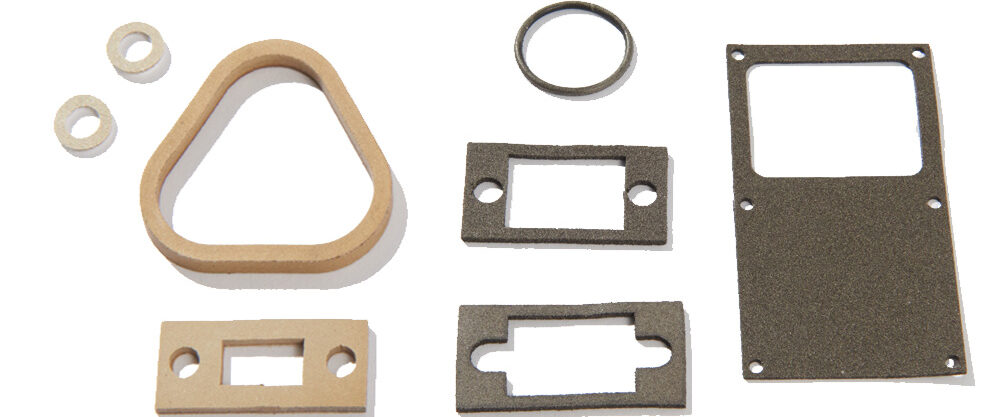
Electrically conductive silicone materials combine environmental sealing with shielding against electromagnetic interference (EMI). Silicone is inherently electrically insulating, but metal or metal-coated fillers are added during compounding to provide electrical conductivity. Two of these filler materials are silver-coated aluminum particles and nickel-coated graphite particles.
Stockwell Elastomerics converts silver-aluminum and nickel-graphite silicones into EMI gaskets for enclosure sealing and shielding. These EMI shielding materials support compression molding and a choice of cutting methods. For design engineers, material selection involves comparing electrical conductivity, shielding effectiveness, galvanic corrosion resistance, and cost tradeoffs.
Electrical Conductivity
Silver-aluminum and nickel-graphite silicones differ in terms of volume resistivity, a measure of a material’s ability to oppose the flow of electrical current. A higher volume resistivity value indicates that a material is a better electrical insulator, and a lower value indicates higher levels of electrical conductivity. Typically, volume resistivity is measured in ohm-centimeters (Ω‑cm).
Most silver-aluminum silicones have a volume resistivity around 0.003 Ω‑cm. That’s lower than the typical 0.01 Ω‑cm for nickel-graphite silicones. Silver-aluminum silicones have higher electrical conductivity. Consequently, they support more efficient current flows across EMI gaskets and better performance in RF and microwave systems, avionics, and mission-critical electronics.
Shielding Effectiveness
Shielding effectiveness (SE) is measured in decibels (dB) and describes how well an electrically conductive silicone attenuates electromagnetic interference. SE is affected by enclosure geometry and compression, but filler type is a primary driver. Silver-aluminum provides superior SE but nickel-graphite offers reliable attenuation for many applications.
Most silver-aluminum silicones provide >100 dB shielding effectiveness. By contrast, nickel-graphite materials typically provide 80 to 100 dB. That’s suitable for commercial electronics and mid-range attenuation, but military and aerospace electronics may need silver-aluminum silicones that attenuate higher frequencies and meet MIL-DTL-83528 Class A or B requirements.
Galvanic Corrosion
Galvanic corrosion occurs when two different metals contact each other and conduct electricity in the presence of water or moisture, especially saltwater or salt-fog. When clamped to an aluminum flange, an EMI gasket that contains silver-aluminum particles can have an electrochemical potential difference of > 1.0V. This creates a galvanic cell that corrodes the metal enclosure.
Nickel‑graphite offers significantly better galvanic compatibility. Because nickel’s anodic index is closer to aluminum’s, there’s a reduced voltage differential for lower corrosion risk. Consequently, nickel-graphite silicones are a better choice for marine environments, outdoor enclosures, telecommunications hardware, and high-humidity or salt-fog conditions.
Cost Tradeoffs
Cost is a major driver in EMI gasket material selection, especially for high-volume fabrication. Silver-aluminum fillers cost less than pure silver ones, but silver-aluminum is still significantly more expensive than nickel-graphite. Consequently, silver-aluminum silicones are reserved for applications that require ultra-low volume resistivity or >100 dB attenuation.
Nickel-graphite costs less and has better galvanic compatibility, but they can’t match silver-aluminum in terms of electrical conductivity or shielding effectiveness. In addition to telecommunications hardware, nickel-graphite silicones are used with commercial electronics, industrial controls, and unmanned systems for non-military applications.
Compare Electrically Conductive Silicone Materials with Stockwell
Stockwell Elastomerics is an experienced EMI gasket fabricator that serves military and civilian customers, helps engineers with material selection, and offers design reviews. Whether your volumes are large or small, Stockwell can meet your needs. To talk to our Applications Engineering Team, complete our on-line form, email service@stockwell.com, or call (215) 335-3005.