Monday, October 27, 2008

Why Stockwell is a Sensible Strategic Partner in this Rough Economy


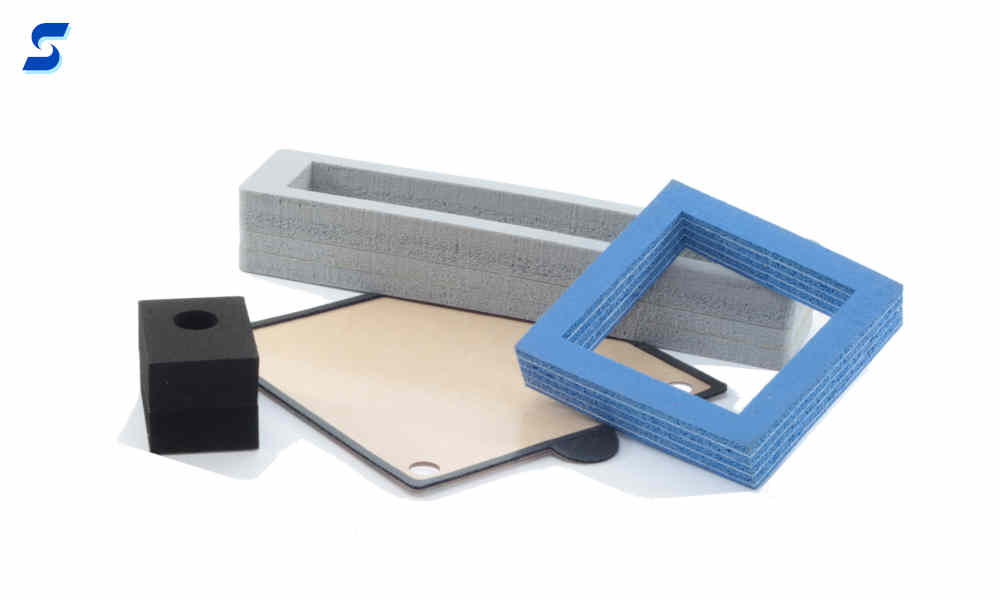
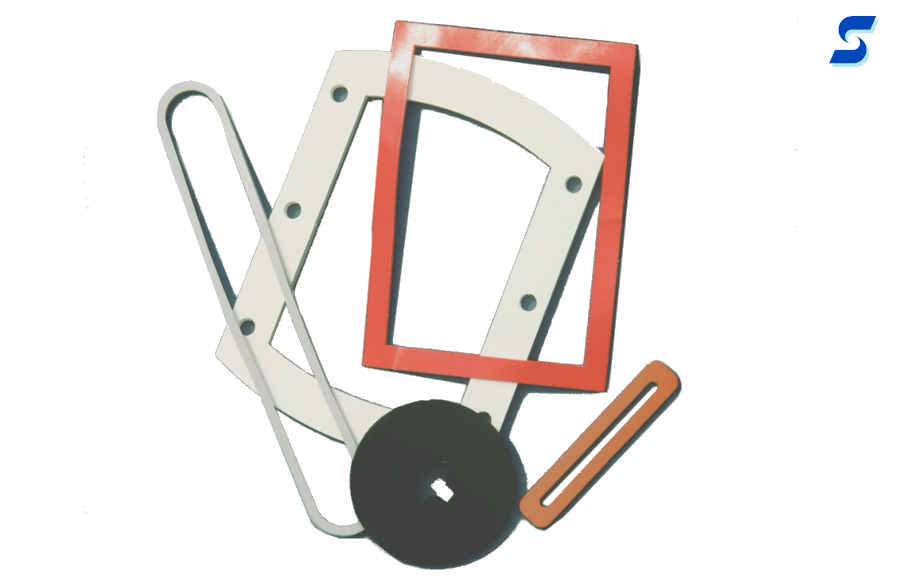
Stockwell Elastomerics’ business model has been centered around low to mid volume runs, quality and speed. For companies practicing Lean Manufacturing this business model makes good sense. Stockwell maintains stock in its core product lines such as Silicone Foams, Silicone Sponge, Solid Silicone, Poron, Thermal products, EMI gasketing materials, and Pressure Sensitive Adhesives (PSA). This stock along with quick changeovers and semi-automated production equipment (Die Cutting, Water Jet Cutting, Slitting and Laminating) allows for fast turns on low to mid-volume runs.


In the current economic climate, overproduction and inventory are much more of a liability than they were a year ago. With some customers relying on lines of credit and banks being more cautious, the risk of orders being cancelled and OEM’s being left holding the bag is much greater. Having a fast turn supplier such as Stockwell who can run smaller batch sizes and still meet long term production needs with scheduled releases allows OEM’s to have less “skin in the game”.

For more information on how Stockwell can meet your production needs, please contact us at 215-335-3005, service@stockwell.com or visit our website http://www.stockwell.com/.

Labels: , , , ,

Tuesday, August 19, 2008

THICK EMI GASKET & EMI GASKET OPTIONS


Stockwell Elastomerics provides custom EMI gaskets regularly for a wide range of customers. Each application is a bit different; some can be cut from “off the shelf” sheets of nickel graphite filled silicone and others may require special fluorosilicone compounds or silver plated particle filled silicone for more conductivity. Generally materials are .062” thick or thinner with a few conductive compounds available up to .125” thick. So what are the options for thicker EMI / NEMA seals? Below are a few pros and cons for different manufacturing techniques for EMI gaskets.


Option 1 – Mold the Gasket
Pros: You can control your design; sealing beads and 3 dimensional shapes are possible. Material savings; EMI compounds cost more that unfilled non-conductive compounds. Compression molding minimizes raw material waste.
Cons: Molds are more costly than tools used in die cutting, and molded parts have longer production lead times than die cut or water jet cut gaskets.

Option 2 – Mold Sheets and Water Jet Cut
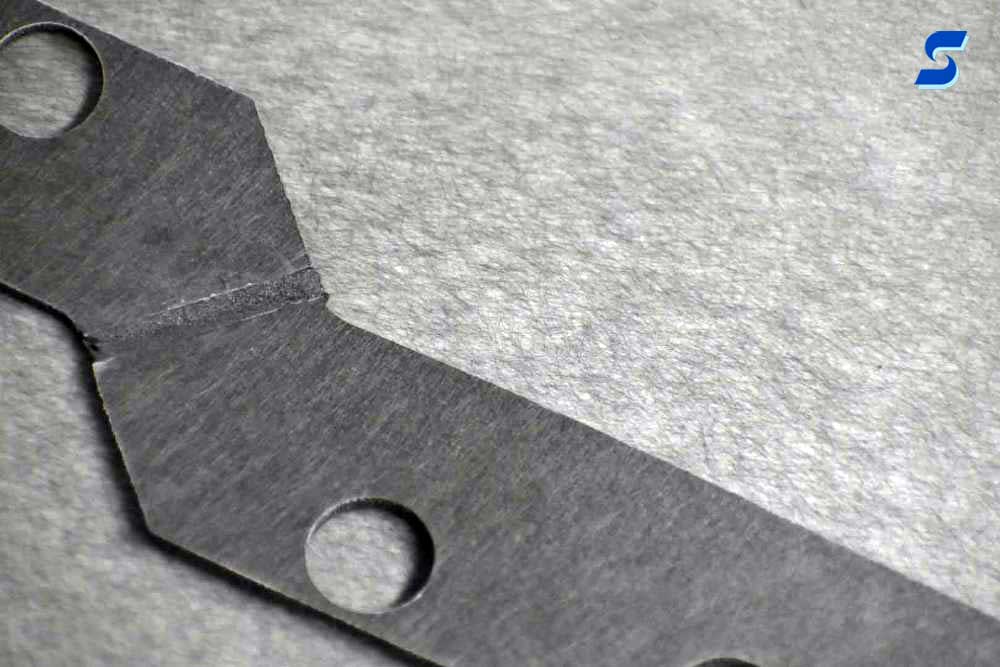
Pros: If a part is smaller or there is little center waste, molding sheets from a standard sheet mold and then waterjet cutting the part geometry may be most feasible. This option offers flexibility in material thickness (.020” to .500”), conductive adhesive backings, and there is no tooling charge for the waterjet cutting process if a CAD file is provided. Lead times for this option are relatively short based on using our in-house 12” x 12” sheet tooling.
Cons: Geometries are limited to 2 dimensions and there is some edge and center waste.

Option 3 – Non-conductive sponge or foam with a bonded conductive wire mesh
Pros: This option offers another range of flexibility. Stockwell uses its core silicone foams and silicone sponge products (with or without adhesive backing) and bonds a Monel (Nickel/Copper alloy) wire mesh to the inside or outside edge of a gasket. This option offers lower compression forces, UL94 V0 foam option, closed cell sponges and a variety of thicknesses cut from standard, readily available roll or sheet stocks. Waste is less costly due to the non-conductive and expanded polymer. Lead time for smaller or initial volumes is relatively quick.
Cons: Geometries are limited to 2 dimensions. There is some assembly which may require scheduled shipments. Heavy compression and release cycles may disturb the mesh to polymer bond.


For more information about EMI gaskets, custom EMI gasket, silicone gaskets or other Stockwell products call 215-335-3005, email service@stockwell.com or visit our website at stockwell.com.


Labels: , , ,

Tuesday, July 08, 2008

Gasket Compression Pecentage Calculation


720 lb Clamp, Foot Print / Contact Area Foot Size: 3" x 12" each
Total Area: 2 x 36in² = 72 in²


HT-800 Silicone Pad Size: 3" x 12" each
Total Area: 2 x 36in² = 72 in²


Mounting Plate


Calculation: Load / Area = 720lb / 72 in² = 10 lb/in²

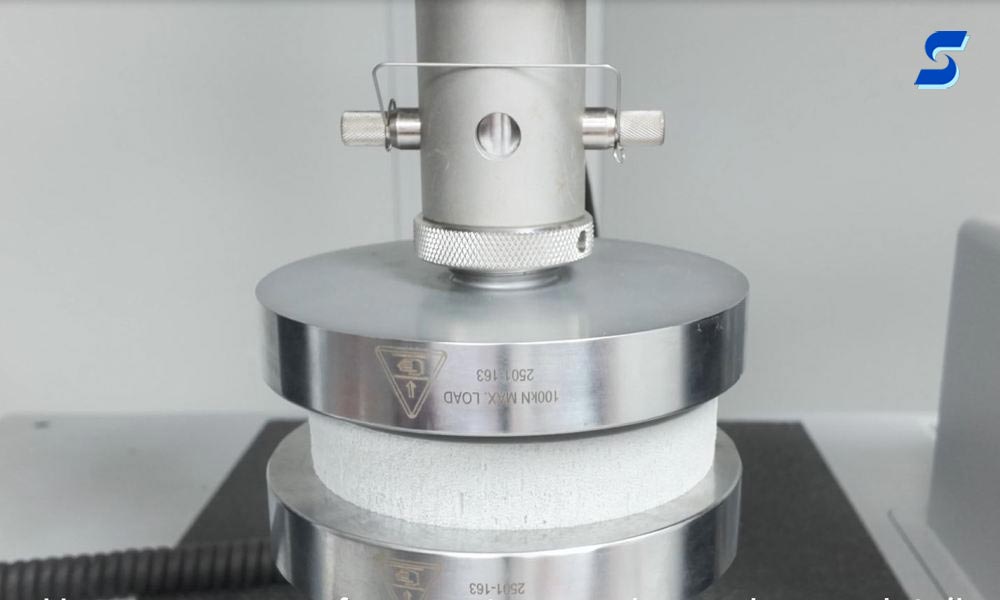
Compression: From the Compression Force Deflection Curve, HT-800 will compress approximately 30%. (Note, compressing more than 50% may rupture cells and damage material)


For more information or applications assistance, please contact Stockwell Elastomerics (215-335-3005 or service@stockwell.com

Tuesday, June 03, 2008

Acrylic Adhesive Backed Silicone Gaskets

Is Silicone PSA required for silicone material?
We often see silicone based adhesive specified with silicone materials. Silicone adhesives are expensive as compared to acrylic adhesives, in some cases more than 5 times the cost of acrylics. Silicone PSA’s bond strength is not as good as acrylics and there are limited offerings. So why are silicone adhesives being specified? Silicone adhesives can be adhered to silicone material without surface preparation. Many fabricators do not have the technology to apply acrylics to silicone materials, however Stockwell has been doing it for years.

When should silicone adhesives be specified?
Silicone adhesives do have their niche, they are great for very low and high temperature extremes where acrylics and rubber based adhesive lose their efficacy.

Having a Pressure Sensitive Adhesive (PSA) backing on gaskets is not required to make a good seal but is often recommended to aid in assembly. The added cost of the adhesive is offset quickly with the time saved during assembly.
For more information about materials contact visit Stockwell Elastomerics at stockwell.com or call 215-335-3005.

Labels: , , ,

Wednesday, May 21, 2008

UMPC (Ultra Mobile Personal Computer), Ruggedizing Components - Overview

There is a new breed of personal computers on the market today, the Ultra Mobile PC. One of the obvious driving sectors for these products is the military where sensitive electronics are exposed to harsh environments. These UMPC’s or ultra rugged computers have also been used commercially in a limited capacity but with the mobile device market on a steep incline, consumers are demanding a greater level of protection for their mobile devices.

In January of 2000 the DoD released standard MIL-STD-810F which is a very comprehensive guide for Environmental Engineering Considerations and Laboratory Testing Procedures. This covers temperature, vibration, shock, EMI shielding, fluid contamination, etc…

Stockwell has been “Ruggedizing” electronics for many years. The key to achieving a truly rugged component is in the materials. For example, if a device is exposed to extreme low temperature and dropped it will rely on the cushioning pad for protection. Traditional “rubber” will firm up and pass the energy on to the internal components, ultimately leading to a device failure. A silicone foam product is a good choice for mechanical shock and vibration in extreme temperatures, silicone maintains cushioning properties below -80°F. Where fuel and chemicals may make contact with the elastomeric cushion, a closed cell fluorosilicone sponge might be the better choice.


Stockwell has a wide range of materials to meet the most demanding ruggedizing requirements, including; chemical resistant, soft sponges and foams for cushioning and damping, EMI shielding materials, open cell and closed cell products for dust and water sealing. Production capabilities include custom molding, fast-turn water jet cutting, die cutting and adhesive laminations.

Labels: , , , ,

Wednesday, April 09, 2008

High Performance Acrylic Adhesives on Silicone


In recent months we have seen more requirements for Silicone Foam and Closed Cell Silicone Sponge Enclosure Gaskets and Cushioning Pads requiring high strength pressure sensitive acrylic adhesives for bonding to powder coated metal surfaces and certain low surface energy plastics.


Secure lamination of acrylic pressure sensitive adhesives onto silicone rubber is not possible without priming the silicone rubber. Stockwell has developed primers that allow for lamination of 3M Corporations’ 9485 acrylic transfer film adhesive and 9490LE film supported acrylic adhesive onto silicone foam, closed cell silicone sponge and solid silicone rubber.


3M 9485 acrylic adhesive is .005” thick unsupported transfer film adhesive. Its ultimate bonding strength on stainless steel is 150 lbs / inch of width. 9485 withstands high temperature excursions for brief periods up to 400°F, and long term temperatures up to 300°F continuous without slumping or shearing. This adhesive is well suited for thick silicone sponge gaskets on most metal surfaces. Unsupported transfer film adhesives allow for bonding to contoured surfaces and permit forming corner radii using strips of gasketing.


3M 9490LE acrylic adhesive is .0067” thick film supported adhesive. This adhesive is formulated for secure bonding to most surfaces, including many low surface energy plastics and powder coated metal surfaces. 9490LE withstands high temperature excursions for brief periods up to 300°F, and long term temperatures up to 200°F. Film supported adhesive backings provide dimensional stability, which may benefit the assembly of thin-walled gaskets onto some enclosure designs.

Monday, March 17, 2008

Rubber? - Rubber Gasket, Rubber Seals, Rubber Pads…

It is interesting how the word “rubber”, which historically has referred to Natural Rubber (also known as isoprene) has become a general term for elastomeric materials. Natural rubber is the original elastomer; however, over the years there have been many more synthetic polymers developed, each with its own unique property.

From an engineering standpoint it is important to know the demands and environmental conditions to which a “rubber” component will be exposed. Many of us have seen a black, flaking, cracking gasket essentially at a failure state. For a critical water seal the cracking could allow leaks causing damage to expensive electronics. For pads, excessive compression set (when the elastomer fails to rebound) may be the mode of failure, ultimately transferring mechanical shock or vibration to the device. Many of these common failures can be avoided with proper material selection. Temperature, UV, ozone, and chemicals all play a role in how well a “rubber” part will survive. Stockwell helps customers with material selection and in most cases will provide samples at no charge for testing.


For more information about materials contact visit Stockwell Elastomerics at stockwell.com or call 215-335-3005

Labels: , , ,