Contact Stockwell Elastomerics
Request a quote or get more information.

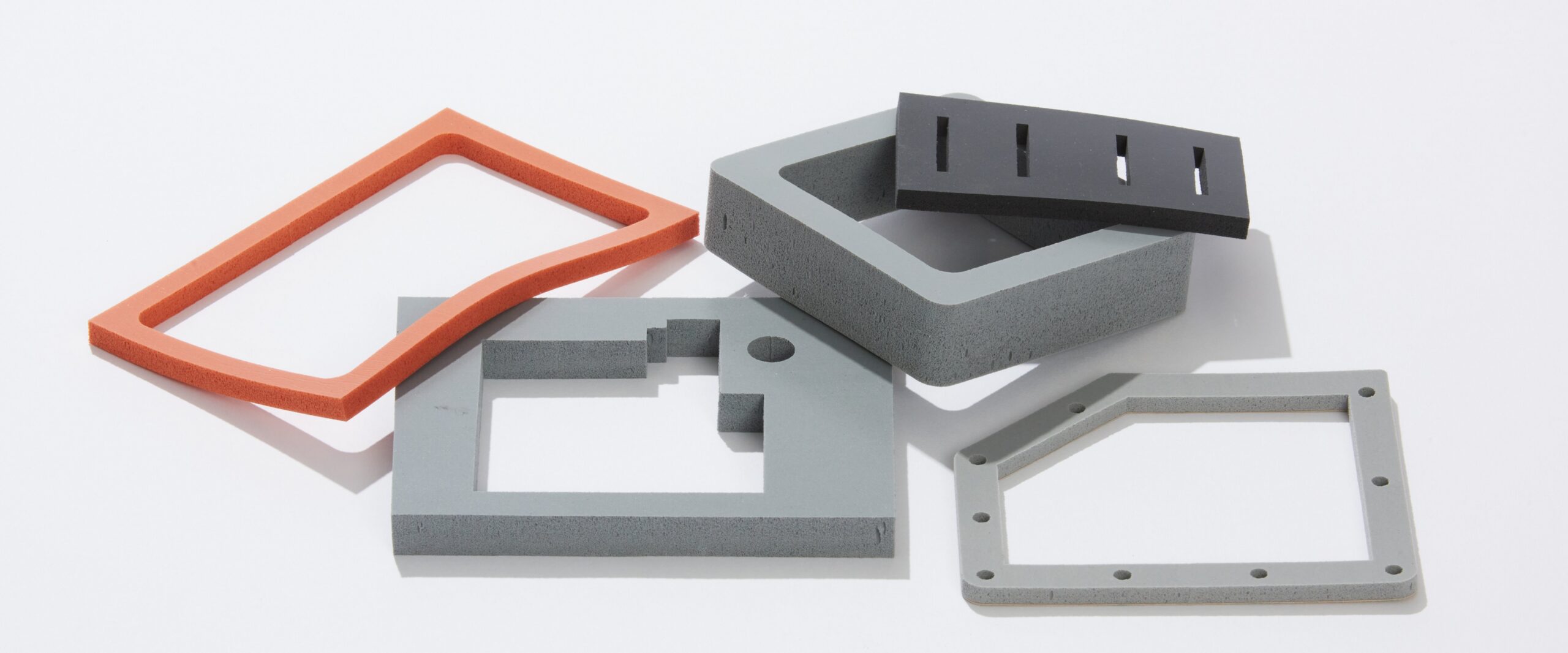
Closed cell silicone foams seal out water when they are compressed. This makes them a good choice for sealing enclosures against moisture: small amounts of liquid (usually water) that are diffused, absorbed, or condensed on surfaces or within a material. Whether it’s from humidity, condensation, or dew, the ingress of moisture can damage or degrade electrical contacts and electronics.
Stockwell Elastomerics sources sheets of closed cell silicone foam from industry-leading partners and converts these materials into seals and gaskets. More specifically, the closed cell silicone foams that we stock and fabricate are modified versions of traditional closed cell silicone foam materials. That’s an important distinction during material selection.
What is Modified Closed Cell Silicone Foam?
Traditional closed cell silicone foam and modified closed cell silicone foam are closely related; however, they can behave differently in applications that require moisture sealing under low-to-moderate clamping from enclosure fasteners. Traditional closed cell silicone foams offer excellent moisture sealing, but they can be too stiff or difficult to compress in some enclosure designs.
Through adjustments to cell structure, density, and polymer formulation, modified closed cell silicone foams their keep their moisture-blocking benefits while offering greater compressibility, softness, and conformability. In some cases, these materials behave like a hybrid between traditional closed cell foam and open cell foam.
Low-to-Moderate Compression and Moisture Management
Modified closed cell silicone foams that support low-to-moderate clamping forces are a good choice for thin wall enclosures or plastic housings that can deform under excessive loads and allow moisture to enter. Due to the closed cell structure, air is maintained in the cells of the foams. This gives the gasket higher deflection levels that resist the motion or deformation that occurs in response to an applied load – they also reduce stress on fasteners.
There are other benefits to using these materials as well. Because they are conformable, modified closed cell silicone foam can fill uneven enclosure surfaces where moisture could enter. These materials are also more forgiving in tolerance stack-ups. There are differences in terms of firmness however engineers can choose medium, firm, and extra firm grades.
Closed Cell Silicone Foams: Deflection and Firmness
The table below describes closed cell silicone foam materials that Stockwell Elastomerics sources from trusted partners and can fabricate into finished products.
| Material | Manufacturer | Brand | Deflection (psi) | Firmness |
|---|---|---|---|---|
| HT-800 | Rogers | BISCO | 6 - 14 | Medium |
| F-20 | Saint-Gobain | Norseal | 6 - 14 | Medium |
| FG-20 | Saint-Gobain | Norseal | 3 - 10 | Medium |
| HT-820 | Rogers | BISCO | 12 - 20 | Firm |
| HT-840 | Rogers | BISCO | 16 - 26 | Extra Firm |
Deflection is the pressure (psi) that’s required to compress a material to a specified percentage of its thickness, typically 25% or 50%. In other words, it indicates the amount of force that a gasket needs to achieve the required compression for proper sealing. Firmness is related to deflection and describes the same mechanical behavior, but with standard terms instead of numeric values.
For moisture management, a closed cell silicone foam with a firmness grade of medium or firm can provide sealing under low-to-moderate clamping pressures. Because materials with higher deflection withstand stronger sealing pressures, extra-firm closed cell silicone foams are used in IP67/IP68, outdoor, and wash-down enclosures instead.
Find Closed Cell Silicone Foams
Understanding the basics of closed cell silicone foams is important, but design engineers must also identify a specific material for enclosure moisture management. Stockwell Elastomerics can help you with material selection and review your gasket design. To talk to our Applications Engineering Team, complete our on-line form, email service@stockwell.com, or call (215) 335-3005.