Contact Stockwell Elastomerics
Request a quote or get more information.

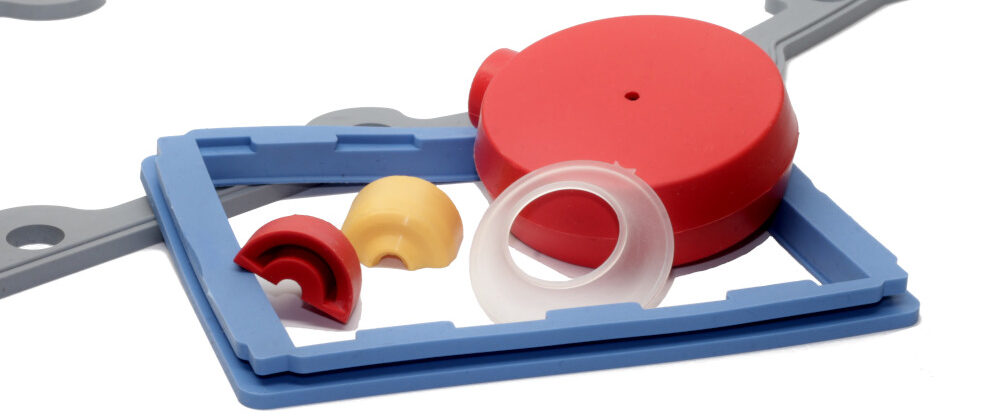
Silicone gaskets offer exceptional performance in harsh environments, but not all silicones are the same. Engineers should evaluate durometer, compression set, thermal cycling, chemical resistance, and UV/ozone stability—selecting solid, sponge, foam, or fluorosilicone materials based on application stress and exposure.
What makes silicone gaskets ideal for harsh environments?
Silicone rubber retains flexibility and sealing integrity across a wide temperature range (typically –60 °C to +230 °C) and resists ozone, UV, and weathering better than most elastomers. For applications such as aerospace controls, outdoor telecommunications, or semiconductor tools, silicone gaskets provide long-term sealing stability where EPDM or neoprene would degrade.
Stockwell Elastomerics supplies engineered silicone gasketing materials from industry leaders including Rogers Corporation, Saint-Gobain, and Specialty Silicone Products (SSP). These include:
| Material Type | Cell Structure | Typical Applications | Notes |
|---|---|---|---|
| Silicone Sponge | Closed-cell | Outdoor NEMA enclosures, base stations | Excellent IP-rated sealing under compression |
| Silicone Foam | Open- or closed-cell | Instrument housings, LED fixtures | Available in UL 94 V-0 rated grades |
| Solid Silicone | Non-cellular | High-pressure or rigid enclosure seals | Tight-tolerance die-cut and molded gaskets |
| Fluorosilicone | Solid or sponge | Chemical/fuel-exposed aerospace systems | Resists hydrocarbons, solvents, and de-icers |
How do key material properties influence gasket performance?
Selecting a gasket for harsh conditions requires more than specifying “silicone.” The following parameters guide optimal performance:
1. Firmness
Firmness is measured differently based on the type of material used. For silicone sponges and foams, Compression Force Deflection (CFD) is used. CFD is a measurement of pressure required to deflect a material by 25%.
The CFD of material is typically specified based on the available force to drive compression.
For solid silicones, durometer, measured on the Shore A scale, defines the gasket’s firmness and ability to conform.
2. Compression Set
Compression set quantifies a gasket’s ability to rebound after compression.
Silicone’s inherent resilience outperforms many organic elastomers such as neoprene or nitrile.
3. Thermal Cycling Resistance
Repeated heating and cooling can induce expansion–contraction stresses. Silicone’s low glass-transition temperature and thermal stability (up to 230 °C continuous, 260 °C intermittent) allow reliable sealing through rapid cycles without cracking or embrittlement.
4. Chemical Compatibility
Standard silicone resists polar solvents, weak acids, and salts, but not hydrocarbons or concentrated acids.
5. UV and Ozone Resistance
Silicone’s inorganic Si–O backbone provides exceptional resistance to ozone cracking and UV degradation. This makes it ideal for outdoor applications such as telecom cabinets, LED fixtures, and aerospace radomes.
What engineered silicones are recommended for proven reliability?
Stockwell Elastomerics commonly specifies:
All can be die-cut, waterjet-cut, or molded with pressure-sensitive adhesive backings to simplify assembly.
How does Stockwell support engineers specifying materials for extreme conditions?
Stockwell Elastomerics’ applications engineers collaborate directly with design teams to match material performance with environmental exposure. Our in-house R&D engineer supports ongoing formulation testing, adhesive validation, and prototype fabrication—helping customers accelerate qualification for demanding aerospace, defense, and semiconductor sealing projects.
Request a Rapid Silicone Gasket Sample
Partner with Stockwell Elastomerics’ applications engineers to specify, prototype, and validate silicone gasket materials for your harsh environment sealing challenges. Request a rapid silicone gasket sample today.