Contact Stockwell Elastomerics
Request a quote or get more information.

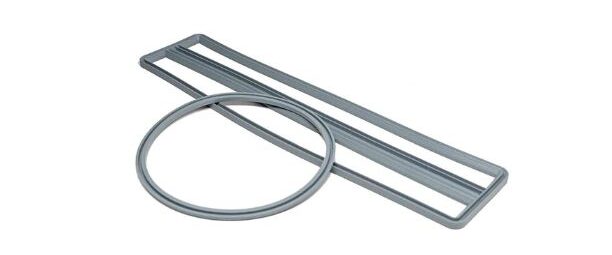
Gasket failures in aerospace and medical systems can cause downtime, rework, and potentially hazardous conditions. To ensure sealing success, engineers need to understand the causes of gasket failure and follow design strategies that minimize risks such as fluid leakage, contamination, and pressure losses.
This article from Stockwell Elastomerics contains key specifications for avoiding common gasket failures. It’s divided into five major areas.
Tolerance Stacks
Tolerance stacks, or tolerance stack-ups, are cumulative dimensional variations among mating parts. In gasketed assemblies, even small deviations can compromise seal integrity. For example, problems with tolerance stacks in an aerospace assembly can result in uneven gasket compression with fuel or hydraulic seals. Medical devices such as infusion pumps need to avoid tolerance issues that could allow micro-leaks and compromise sterility.
To prevent problems like this, perform a tolerance stack analysis early in the design phase. Use integrated computer-aided design (CAD) tools and consider worst-case scenarios rather than average values. Also, make sure to specify gasket durometer and compression ranges that can accommodate these dimensional variations. Finite element analysis (FEA) software can simulate gasket deformation under tolerance extremes.
Stress Relief
Compression and vibration cause mechanical stresses that can result in cracking or a loss of elasticity. In the aerospace industry, engine vibrations may cause fatigue at gasket interfaces. With medical devices, repeated autoclaving can expose gaskets to thermal expansion and contraction that stresses the elastomer. Silicone rubber can resist thermal cycling and absorb vibrations, but material selection alone won’t ensure sealing success.
Select gasket materials with low compression set and high resilience. Also, consider incorporating stress-relief features such as spring-loaded fasteners. In addition, avoid sharp corners or rigid clamping that can concentrate stresses. For applications with extreme temperature changes, consider the thermal expansion coefficients of each material in gasket design calculations. With enclosures, the gasket material and the housing material need to expand at or near the same rate. Various silicones, such as heat press pads / thermal gap fillers, can accommodate this need in applications where housing materials are highly thermally conductive. This ability to match the enclosure is material selection dependent. For assistance, please contact our applications engineering team.
Seal Geometry
Seals with unique or complex geometries may compress unevenly or allow contaminants such as moisture or dust to accumulate. If O-ring grooves or gasket design lack proper dimensions, the gasket material can become distorted under high differential pressures in aircraft cabins or avionics enclosures. In medical instruments flat die cut gaskets need to be free from crevices where biofilms could accumulate. Different gasket cutting and fabricating processes may yield different cut profiles.
To ensure predictable compression, consider standardized groove designs such as AS568 for aerospace O-rings. For flat gaskets used with medical devices, design flush features that avoid crevices and support sterilization. With all elastomeric gaskets, avoid excessive compression. Depending on the elastomer and the compressive force, 20% to 30% compression may be adequate.
Bonding/Adhesion
Gaskets can be bonded to substrates with adhesives to prevent loosening, leakage, or misalignment. For example, EMI gaskets for avionics can be bonded to enclosures so that these seals remain in place despite high vibrations and significant thermal cycling. In medical diagnostic equipment, adhesive-backed gaskets that can withstand chemical cleaners or device fluids are needed.
Select adhesives that are compatible with both the gasket material and the substrate / device materials. Use peel and shear testing to validate the adhesive under application-specific conditions. If surface preparation is required, make sure to clean or roughen the substrate. For permanent bonding, consider using an adhesive to bond the elastomer to the substrate during vulcanization or other post assembly processes.
Accelerated Life Testing
Accelerated life testing (ALT) helps to predict a gasket’s long-term performance. In the aircraft industry, for example, ALT simulates high-altitude pressure cycles and exposure to jet fuel and vibrations. In the medical device industry, ALT replicates sterilization cycles, chemical cleaning, and mechanical wear.
For best results, define ALT protocols based on real-world conditions such as 10,000 pressurization cycles for an aerospace gasket or 500 autoclave cycles for a medical device seal. Monitor compression set, leakage rates, and adhesion strength (if applicable) during testing. Then, apply statistical models such as Weibull analysis to extrapolate service life from ALT data.
Discuss Potential Gasket Failures
Contact Stockwell Elastomerics to review your gasket and offer material options. Ask to speak with of a member of the Applications Engineering Team through service@stockwell.com or 215-335-3005.